


- Research
PICRC Publishes Study Investigating Movement Patterns of the Longnose Emperor
The Palau International Coral Reef Center (PICRC) has recently completed a three-year study on a spawning aggregation of the longnose emperor (melangmud, Lethrinus olivaceus). Spawning aggregations occur when individuals of the same species gather in large numbers at specific locations and times—often linked to lunar phases—to reproduce. These aggregations are highly vulnerable to overfishing, as fishers know exactly where and when to target them. Information on the timing, location, and movement patterns of fish at and around aggregation sites is essential to guide effective management of these important areas.
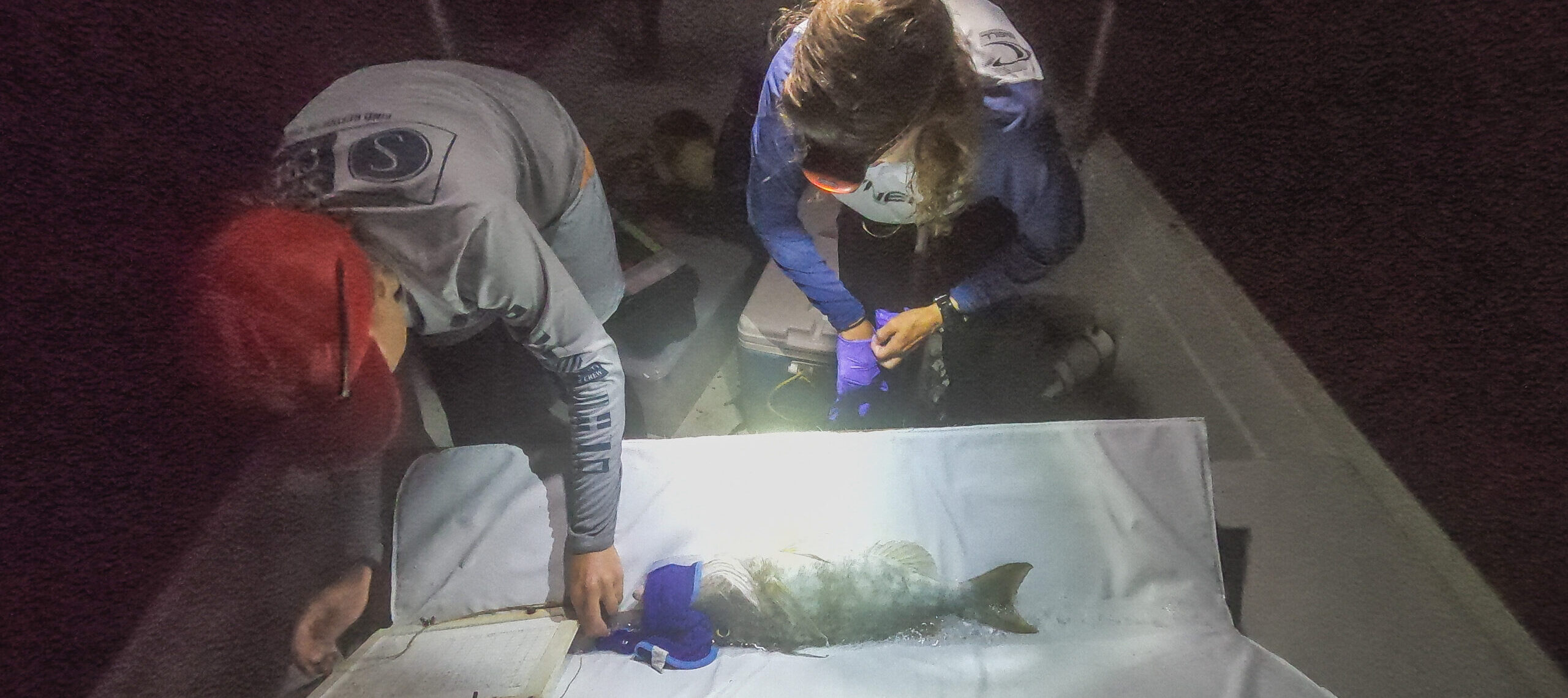
From 2022 to 2025, researchers used a technique known as acoustic tagging to monitor fish movements at and around the aggregation site. This method involves implanting a small tag inside the body cavity of a fish and then releasing it back into the sea. Inside the fish, the tag emits signals that are detected by devices called acoustic receivers, which researchers had previously deployed on the reef. Each time a tagged fish passes near a receiver, the device records the date, time, and ID of the fish, allowing researchers to identify the individual and obtain information on its location at a specific moment. For this project, researchers implanted acoustic tags in 16 longnose emperors, which were captured using bottom fishing. They also deployed 32 acoustic receivers—from Siaes Corner to Blue Corner, along the outer reef and back reef—to track the movements of the tagged fish.
The results revealed that the time of year, lunar phase, and time of day all influence the aggregation of longnose emperors in the study area. Specifically, researchers observed that this species is most abundant at the aggregation site from January to April, from three days before to eight days after the new moon, and during the night.
These findings are consistent with those of a previous study, also conducted by PICRC, in which researchers carried out diver-operated stereo video surveys using GoPro cameras to document the size and density of longnose emperors, and collected gonads (reproductive organs) from the fish to confirm spawning. The acoustic tagging technique also revealed that longnose emperors migrate to the aggregation site along the outer reef, traveling up to 13 km. During non-aggregation periods, many fish disappeared from the acoustic array, likely moving much greater distances into the lagoon or to other aggregation sites.
This study provides important data to inform the Koror Southern Lagoon Coastal Fisheries Management Plan, which proposes protecting the aggregation site to prevent overfishing but currently sets protection dates around the full moon rather than the new moon. Based on their findings, PICRC researchers recommend shifting protection for this species to the new moon period and expanding the protected area, as high numbers of longnose emperors were detected outside the current boundaries during peak aggregation times.
In addition, numerous other species are known or suspected to aggregate at this location at specific times of the year and lunar phase, including four additional species listed in the management plan. This establishes it as a key area for the conservation of many species, including multiple fishery-relevant ones, making its protection a priority. For this reason, the researchers suggest that permanently closing the site throughout the year could be a simpler and more effective conservation measure to ensure the protection of all these species.
This project was conducted as part of a collaboration between PICRC and Stanford University, who also carried out a fish tagging study at this aggregation site, focusing on the red snapper (kedesau, Lutjanus bohar). Results from that study are expected to be published soon. Funding for this study was provided by the Micronesia Conservation Trust Small Grants Program and Irish Aid’s Our Shared Ocean programme.
The full study “Acoustic telemetry reveals spawning aggregation dynamics and management implications for longnose emperor (Lethrinus olivaceus) in Palau”, was published in the journal Fisheries Research in February 2026, and is available open access at https://doi.org/10.1016/j.fishres.2026.107688 and on the PICRC website at www.picrc.org.